A buyer once described what he wanted to me this way: not a house, a legacy.
He didn't mean it as a figure of speech. He meant he wanted to be the kind of owner a historic Nantucket property actually deserves. Someone who'd protect what makes it significant, not just occupy it.
I hear a version of this more often than people might expect.
What Stewardship Actually Means
- For some buyers, a historically significant Nantucket property is a responsibility as much as a purchase.
- All of Nantucket, more than 5,000 structures across the island, sits within a single National Historic Landmark district, the largest of its kind in the country by area.
- Real stewardship goes further than what the law requires: historic-district review covers exteriors, not interiors, and protecting what's inside, plaster, marble, original flooring, hand-carved millwork, is a specialist's job, not a general contractor's.
- This mindset shows up most often among buyers considering the island's oldest and most storied homes.
A Different Kind of Buyer
Most real estate conversations start with square footage, bedrooms, water views.
Some start differently. A buyer will ask about a home's history first. Who built it. What it survived. Whether the widow's walk is original.
These are usually people who already own successfully elsewhere. They're not chasing status. They're looking for a house with a story they can become part of, and eventually pass on.
I think of it as the difference between buying a view and buying a chapter.
What This Actually Requires
Wanting to be a good steward is one thing. Being one is another.
All of Nantucket, not just the downtown core, falls within a single Historic District, its current legal authority arising from a 1970 Massachusetts Special Act, and one of the largest National Historic Landmark districts in the country by area, encompassing more than 5,000 contributing structures. Two areas carry even closer scrutiny within it: the town core and the village of Siasconset, both singled out for what the Commission calls extraordinary consideration. Anything visible from a public way, an addition, new construction, even a roof or a window, needs a Certificate of Appropriateness from the Historic District Commission before it happens, and that approval alone doesn't clear everything else a project might need. Conservation Commission review, Planning Board, zoning, or an association's own rules are still the buyer's responsibility to sort out separately.
What the law doesn't require is the more telling part. HDC review covers exteriors. It doesn't reach interiors, and no other Nantucket authority steps in to fill that gap. A new owner could legally strip a landmark interior down to the studs, and no commission would ever review it, let alone stop it. Nothing prevents that except the owner's own judgment. That's the entire distinction between ownership and stewardship, in one fact. In 2000, enough of that had already happened that the National Trust for Historic Preservation put Nantucket on its list of America's most endangered historic places.
A good steward doesn't stop at what's required. The buyers I mean protect the parts no commission is checking, and I want to be specific about what that actually looks like, room by room.
I recently represented an 1840s Greek Revival mansion on Main Street, documented decades ago by the Historic American Buildings Survey, that turned out to be one of the best-preserved examples of this kind of interior I've encountered. What follows draws on it, and on the broader pattern I see across the island's grandest period homes.
Ornamental Plaster
The most elaborate Nantucket interiors often center on plasterwork: domed ceilings, decorative rosettes, pilasters, sometimes an entire circular stair hall built beneath a hand-modeled dome.
This isn't drywall decoration. Nineteenth-century ornamental plaster was built up in layers, lime plaster or gypsum over a timber or lath substrate, with finer details modeled or hand-finished directly. A curved dome ceiling required real structural geometry underneath before a single coat went on.
Cracked or separated plaster shouldn't be filled with modern joint compound. A specialist first determines whether the plaster has actually separated from its lath, then stabilizes or reattaches it with conservation-grade methods. Where a decorative element like a rosette or capital is genuinely missing, a specialist can mold a matching piece from a surviving original rather than approximate it freehand. An ordinary painter can make old plaster look smooth. A specialist preserves what made it worth preserving in the first place.
Historic Glazing
Colored or leaded glass, often at the center of a domed stair hall, was both practical and theatrical in an era before electric light: it brought daylight into deep interior spaces while turning that necessity into decoration.
It shouldn't be called stained glass unless the glass was actually painted or stained. Much of what survives from this period is colored pot-metal or flashed glass, pieces assembled with lead cames rather than painted directly. The distinction matters for how it's cared for.
Old glazing should never be cleaned with abrasive or ammonia-based products, and never under pressure. A conservator inspects individual panes for cracking, checks for lead fatigue and failing solder joints, and can often relead a damaged panel while keeping the original glass intact, which is almost always preferable to full replacement.
Marble and Historic Masonry
A marble mantel was a genuine luxury in a 19th-century Nantucket home. Every piece of stone arrived by sea before it was ever cut or finished.
Marble is calcium carbonate, which makes it vulnerable to anything acidic, including common household cleaners. It should be cleaned only with mild, pH-neutral methods, and any repair belongs with an architectural stone conservator who can match veining, grain, and finish, not just find a similar-looking slab. Excessive polishing can permanently erase the surface character stone develops over a century or more.
The same caution applies underfoot and underground. In that Main Street house, the original brick floor in the lower level was taken up during renovation, brick by brick, each one numbered, and set back exactly where it started, real conservation methodology, not decorative style. Historic brick flooring and old stone foundation walls were built to work with soft, breathable lime mortar, and a modern, harder Portland-cement repair can trap moisture against old masonry and accelerate exactly the deterioration it was meant to prevent.
Original Wood Flooring
Wide-plank pine flooring is one of the most recognizable features of a grand Nantucket interior, and it's frequently original. Boards over a foot wide came from trees that simply don't exist in commercial supply anymore.
The single biggest risk to a floor like this is over-sanding. Every conventional refinishing removes real material, and after enough cycles a historic floor can lose its structural integrity along with its character. A conservation-minded approach starts by asking whether sanding is even necessary, cleaning, hand-scraping, and a renewed finish often accomplish more than a full sand-down, and any board that genuinely needs replacing is better matched with reclaimed old-growth wood than new lumber. The goal was never to make a 180-year-old floor look freshly installed.
Hand-Carved Millwork
Elaborate door surrounds, deep casings, and carved moldings show up throughout the island's grandest period homes, and even where pattern books and early milling technology were involved, this level of work still required real hand-fitting and carving.
Replacing it with modern stock trim erases most of what makes a room like this feel the way it does. The right approach retains original material wherever it's sound, repairs splits with traditional joinery rather than filler, and reproduces missing profiles by milling from a cast or tracing of an intact section, sometimes finished with genuine hand-carving. It's slower than buying trim off a shelf. That's the point.
Curved Staircases
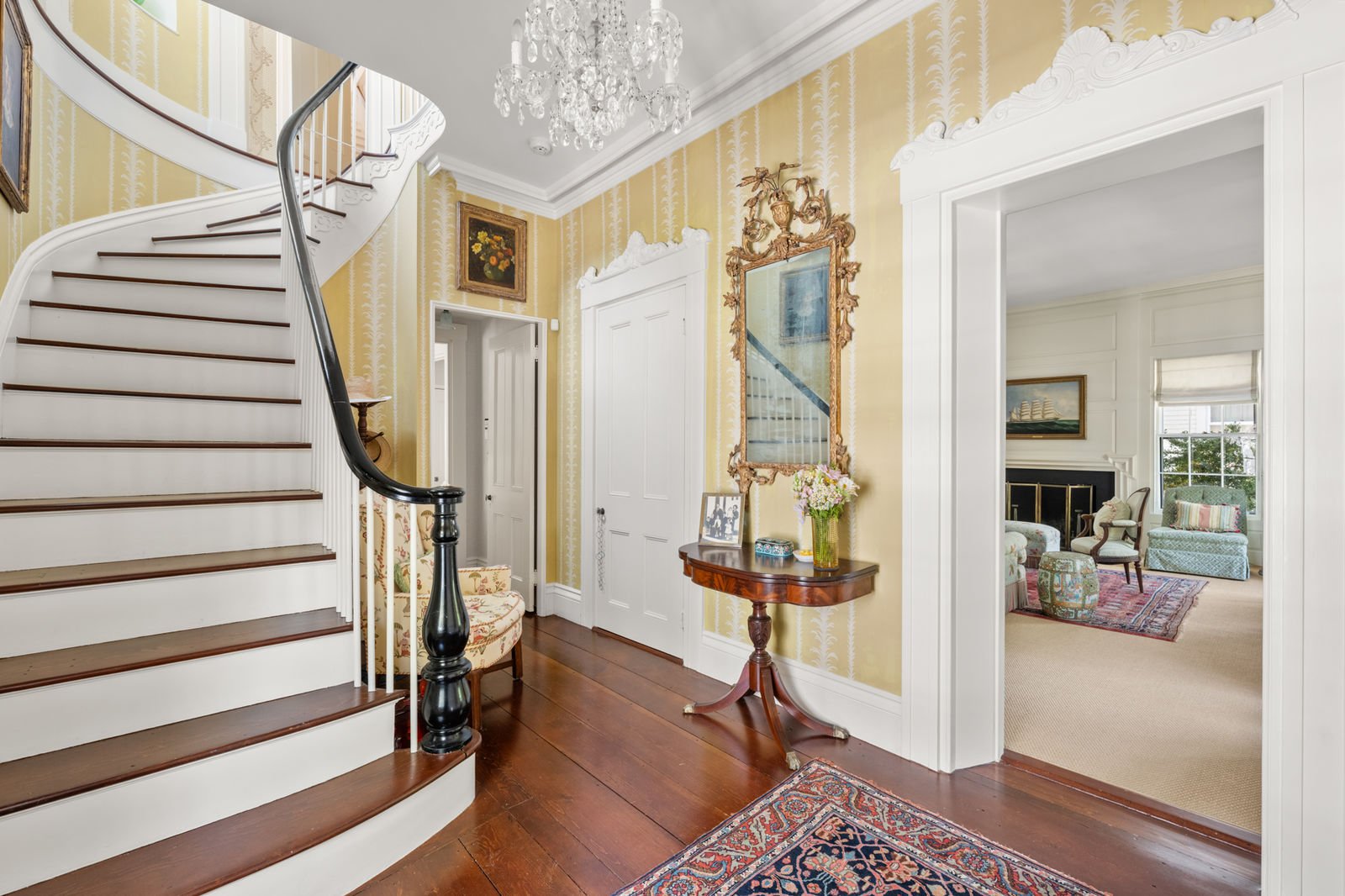
A staircase that curves through a genuine architectural composition, culminating in a circular landing or a domed ceiling above it, represents serious historic joinery. Traditional curved handrails were built from laminated sections or carefully jointed solid stock, shaped entirely by hand.
Damaged components belong with a specialist stair builder, not a general contractor. Loose balusters should be repaired at the joint rather than screwed into place from the front, and old treads are worth keeping wherever they're structurally sound. The small signs of hand construction, a slight irregularity here, a tool mark there, are part of what the house actually is.
For the regulatory side of all this, How to Buy a Luxury Home covers HDC review and the broader luxury-buying process in more depth, and our due-diligence checklist walks through what to verify on a specific property before closing.
When the Right Property Isn't For Sale
Nantucket's most significant homes don't turn over often, and when a buyer asks about a specific one, the honest answer is frequently no, it isn't available.
That's not a dead end. It's usually the start of a longer, more focused search.
I've represented 72 Main Street, one of the island's most storied addresses, and, more recently, another significant Main Street property whose full story I'll be sharing here soon. Between sales like these, I get a real sense of which historic properties exist, which are likely to trade, and which families are quietly, genuinely ready to pass a home on.
That knowledge is often more useful to a steward-minded buyer than any listing search, especially at the very top of the market, where that kind of judgment matters most.
If This Is How You Think About Nantucket
A legacy property search looks different from a typical luxury purchase. It moves on its own timeline. It depends on relationships as much as listings. It rewards patience.
If a house's history matters to you as much as its finishes, that's worth saying early, not after you've fallen for a property that turns out to be all surface.
I'd rather understand what you're actually looking for from the start.
Stewardship and historic Nantucket homes
Questions about buying a historically significant Nantucket home, answered
What does it mean to be a steward of a historic Nantucket home?
For some buyers, owning a historically significant Nantucket property comes with a sense of responsibility beyond the purchase itself: preserving what makes the home significant, maintaining its character through any renovation, and treating ownership as something closer to a legacy than a transaction. It's a mindset more than a checklist, though it does come with real, practical commitments.
Why do some buyers see a Nantucket property as a legacy rather than an investment?
Buyers drawn to the island's oldest and most storied homes are often looking for something a spreadsheet can't capture: a house with real history, one they can become part of and eventually pass on. These buyers frequently already own successfully elsewhere and aren't purchasing for status or yield. They're purchasing for continuity.
What responsibilities come with owning a historically significant Nantucket property?
Historic District Commission review governs anything visible from a public way, additions, new construction, and exterior changes alike, and on the island's oldest homes that can shape what's actually possible. What the review doesn't reach is interiors, and no other Nantucket authority fills that gap. A new owner could legally strip a historic interior down to the studs, and nothing in the review process would stop it. Genuine stewardship generally means protecting both, not just what the Commission checks, because past the front door, the only thing protecting a landmark interior is the owner's own judgment.
How much of Nantucket is actually a historic district?
All of it. Nantucket, along with the smaller islands of Tuckernuck and Muskeget, sits within a single National Historic Landmark district, its current regulatory authority arising from a 1970 Massachusetts Special Act, covering more than 5,000 contributing structures across roughly 30,000 acres, the largest historic district of its kind in the country by area. Two areas within it carry even closer review: Nantucket's town core and the village of Siasconset.
What historic materials are common in Nantucket's grand period homes?
The island's most significant 19th-century interiors often feature hand-modeled ornamental plasterwork, wide-plank pine flooring from old-growth timber, marble mantels, hand-carved millwork and moldings, historic leaded or colored glazing, and masonry built with lime mortar. Each material has its own conservation requirements, and treating them like modern equivalents is the most common way original character gets lost.
What's the biggest mistake buyers make renovating a historic Nantucket home?
Over-sanding original wood floors and using modern cleaning products on marble or historic glass are two of the most common and most avoidable. Both come from treating historic materials like their modern equivalents rather than understanding what makes them different, and both cause damage that generally can't be undone.
Should I hire a specialist for historic home repairs on Nantucket?
For anything involving original plaster, marble, historic glazing, or antique millwork, yes. A general contractor can make historic materials look superficially fine in the short term, but repairing them in a way that preserves their actual character, matching veining in stone, reattaching separated plaster, releading old glass, generally requires someone who specializes in that specific material.
Are Nantucket's most historically significant homes ever available to buy?
Occasionally, but rarely, and often quietly. The island's most storied properties don't turn over often, and a specific home a buyer has in mind may simply not be for sale at a given time. That's usually the start of a more focused search rather than a dead end, since a broker who tracks this segment closely will know which comparable properties exist and which families may genuinely be ready to sell.
How does buying a legacy property differ from a typical luxury purchase?
It tends to move on a longer timeline, depend more on relationships and direct knowledge of the market than on active listings, and reward patience over speed. Buyers serious about this kind of purchase generally do best being upfront about that priority early, rather than after becoming attached to a property that turns out to be more surface than substance.
Expert Perspective
Looking for a Nantucket Property With a Story?
If a home's history matters to you as much as its finishes, Bernadette can help you understand what's actually out there, and what genuine stewardship of a significant Nantucket property really involves.